The story of Jamaican food is not merely a collection of recipes; it is a profound historical narrative written in spices, grains, and traditional cooking techniques. To understand Jamaican cuisine is to understand the history of the island itself—a tale of migration, survival, resilience, and the creative blending of global influences that arrived on its shores over centuries. The heritage of this island's food reflects the complex interplay between the indigenous Taino people, Spanish colonizers, British colonial rule, enslaved Africans, and indentured laborers from India and China, all of whom have left an indelible mark on the Jamaican pot.
The Taino Foundation and Spanish Arrival
Long before the arrival of Europeans, the Taino people—the original inhabitants of Jamaica—shaped the culinary foundation of the island. They practiced agriculture, cultivating crops such as cassava (manioc), sweet potatoes, maize, and beans. Perhaps their most significant contribution to the modern Jamaican palate was the development of the barbecue. The Taino used a wooden structure called a barbacoa to slow-roast meats over an indirect fire, a technique that would eventually evolve into the world-famous jerk method. When the Spanish arrived in the late 15th century, they introduced new ingredients, including citrus fruits, sugar cane, and livestock such as pigs and cattle. These introductions fundamentally altered the food landscape, providing the protein sources that would eventually become staples of the Jamaican diet.
African Influence and the Roots of Resilience
Following the Spanish were the British, who colonized the island in 1655 and established a plantation economy built on the labor of enslaved Africans. This period is the most significant in defining the character of Jamaican food. Stripped of their cultural autonomy, enslaved Africans utilized their ingenuity to turn simple, often discarded rations into sustenance. They brought with them knowledge of yams, okra, and plantains, integrating these into the local diet. The struggle for food security led to the creation of 'provision grounds' on rocky, mountainous terrain where enslaved people could cultivate their own food. This fostered a reliance on ground provisions—tubers such as yam, coco, and dasheen—which remain a cornerstone of the Jamaican breakfast and lunch today. The seasoning techniques developed during this time, using scotch bonnet peppers, pimento (allspice), and thyme, were a form of cultural preservation, grounding the diaspora in the flavors of their homelands.
The Evolution of Jerk
Perhaps the most globally recognized element of Jamaican heritage is 'jerk.' Its origins are deeply tied to the Maroons—enslaved Africans who escaped the plantations and took refuge in the rugged Cockpit Country. To survive and remain undetected, the Maroons needed to cook their food without producing visible smoke that would reveal their camps. They refined the Taino barbacoa technique, burying pits in the ground to roast wild boar seasoned with a fiery blend of scotch bonnet peppers, pimento berries, and native herbs. This preservation method allowed the meat to be stored for extended periods while imparting a signature deep, smoky, and spicy flavor profile. Today, jerk is not just a dish but a symbol of the Jamaican spirit of independence and resistance.
Indian and Chinese Contributions
Following the abolition of slavery in 1834, the British colonial government sought new labor sources, leading to the arrival of indentured laborers from India and China. These groups brought with them their own distinct culinary traditions, which were seamlessly woven into the Jamaican fabric. The Indian influence is most evident in the island’s love affair with curry. Curry goat, a dish now considered an essential component of celebratory meals and Sunday dinners, is a direct legacy of this migration. The use of turmeric, cumin, and coriander became localized as Jamaicans adapted these spices to the ingredients at hand. Similarly, the Chinese community introduced soy sauce, stir-frying techniques, and the use of bok choy and other vegetables, giving rise to distinct dishes like 'chop suey' and the Jamaican-Chinese takeaway style that remains a local favorite.
A Modern Culinary Identity
The synthesis of these diverse influences resulted in a cuisine that is bold, complex, and deeply flavorful. Saltfish and ackee—the national dish—perfectly encapsulates this history. Ackee is an indigenous West African fruit brought to the island in the 18th century, while saltfish (cured cod) was imported by the British as a cheap, durable protein source for plantations. When cooked together with onions, tomatoes, and scotch bonnet peppers, the two disparate ingredients create a dish that is uniquely Jamaican. This evolution proves that Jamaican food is not a static set of rules but an adaptive, living history.
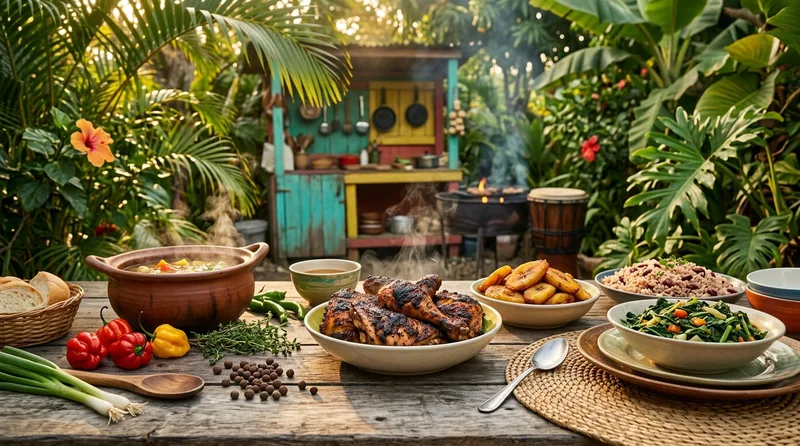
Every ingredient in the Jamaican kitchen carries a weight of history. The Scotch Bonnet pepper brings the heat of the tropics, the pimento adds the aromatic essence of the island's landscape, and the coconut milk provides the creamy richness that defines stews and rice dishes. From the ritual of the Sunday dinner—a family gathering featuring rice and peas, chicken or oxtail, and fried ripe plantains—to the humble patty bought on a busy street corner, the heritage of Jamaican food is a celebration of community and memory. It is a cuisine that has transcended its difficult past to become a global ambassador of culture, influence, and culinary excellence. As we look at the modern landscape, we see that while techniques may become more refined, the soul of Jamaican food remains firmly rooted in the stories of those who cultivated the land and honored their diverse legacies in every bite.